

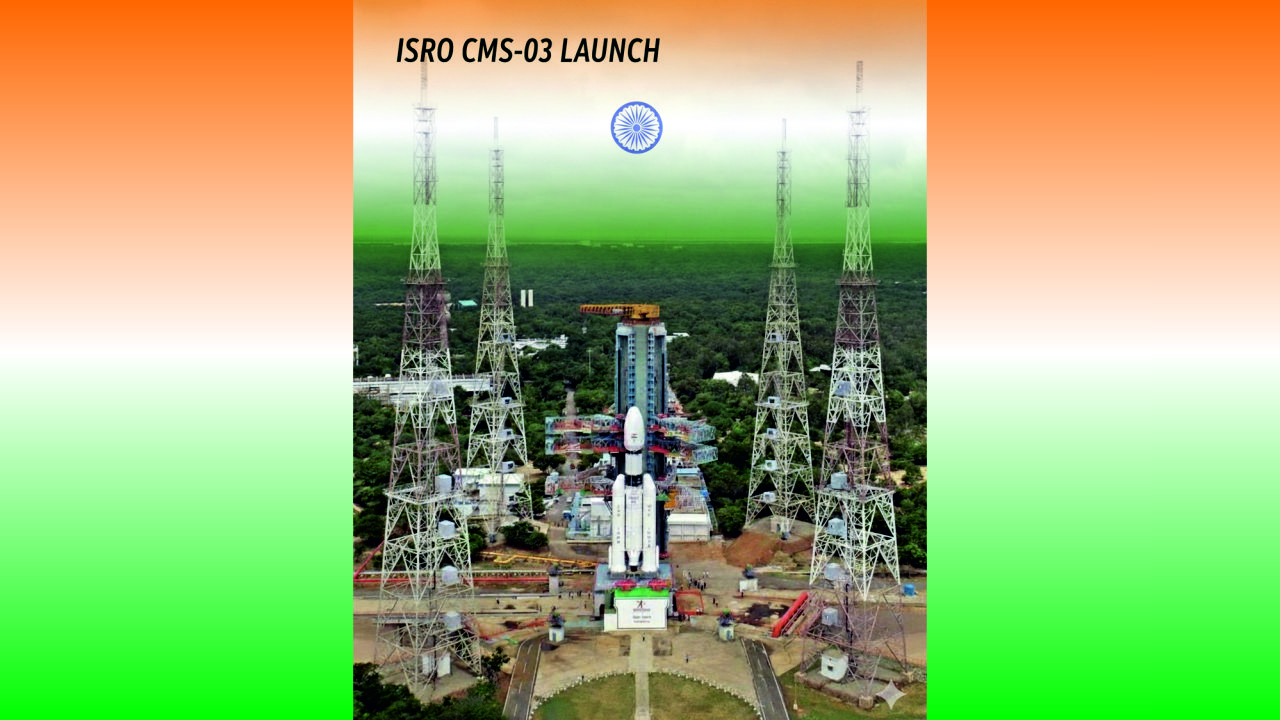
ISRO CMS-03 Launch:
Truly, why is this the Biggest Step Towards Indian Self-Reliance?
Finally, the day is here that we were all eagerly anticipating! We no longer have to rely on foreign soil just to get our crucial communication satellites weighing over 4,000 kg into space. That’s an incredible achievement, isn’t it?
Yes, it’s true! On Sunday, November 2, 2025, the Indian Space Research Organisation (ISRO) wrote yet another massive chapter in history. They used their absolute powerhouse of a rocket, the LVM3-M5. This 43.5-meter-tall, heavy-lift vehicle has been fondly nicknamed ‘Bahubali’ by the ISRO community because of its sheer muscle and capability. And ‘Bahubali’ delivered a stellar performance.
Lifting off from the Second Launch Pad at Sriharikota, the entire process was flawlessly executed. The rocket successfully placed the huge 4,410 kg CMS-03 communication satellite (also known as GSAT-7R) into the Geosynchronous Transfer Orbit (GTO). Just let that sink in! This is officially the heaviest satellite ever launched by ISRO from Indian soil using a domestic rocket—that figure is a monumental record for us.
Previously, if we had a satellite exceeding 4,000 kg, ISRO was forced to rely on foreign providers, particularly Arianespace from their Kourou base in French Guiana. Remember the 5,854 kg GSAT-11? That had to go up on an Ariane-5 back in 2018. But now, with the successful ISRO CMS-03 Launch, that dependence is over. This move is huge; it saves us significant cost and definitively strengthens our technological sovereignty.
The LVM3-M5, also referred to as the Geosynchronous Satellite Launch Vehicle Mark III (GSLV Mk III), performed its fifth operational flight. It maintains a perfect track record, having previously launched the historic Chandrayaan-3 mission that achieved the moon’s South Pole landing in 2023. The rocket is a three-stage marvel: it uses two S200 solid rocket boosters (developed by VSSC) for the initial push, then the L110 liquid stage with its Vikas engines, and finally the powerful cryogenic upper stage. The LVM3 is certified to carry up to 4,000 kg to GTO and a remarkable 8,000 kg to Low Earth Orbit (LEO).
The CMS-03 satellite itself is a multi-band communication workhorse designed to provide a secure and high-capacity communication network, particularly benefiting the Indian Navy and strengthening our overall defense posture. All in all, this mission proves beyond a shadow of a doubt that India is rapidly achieving its goal of becoming a global, self-reliant space power!
More Article-