
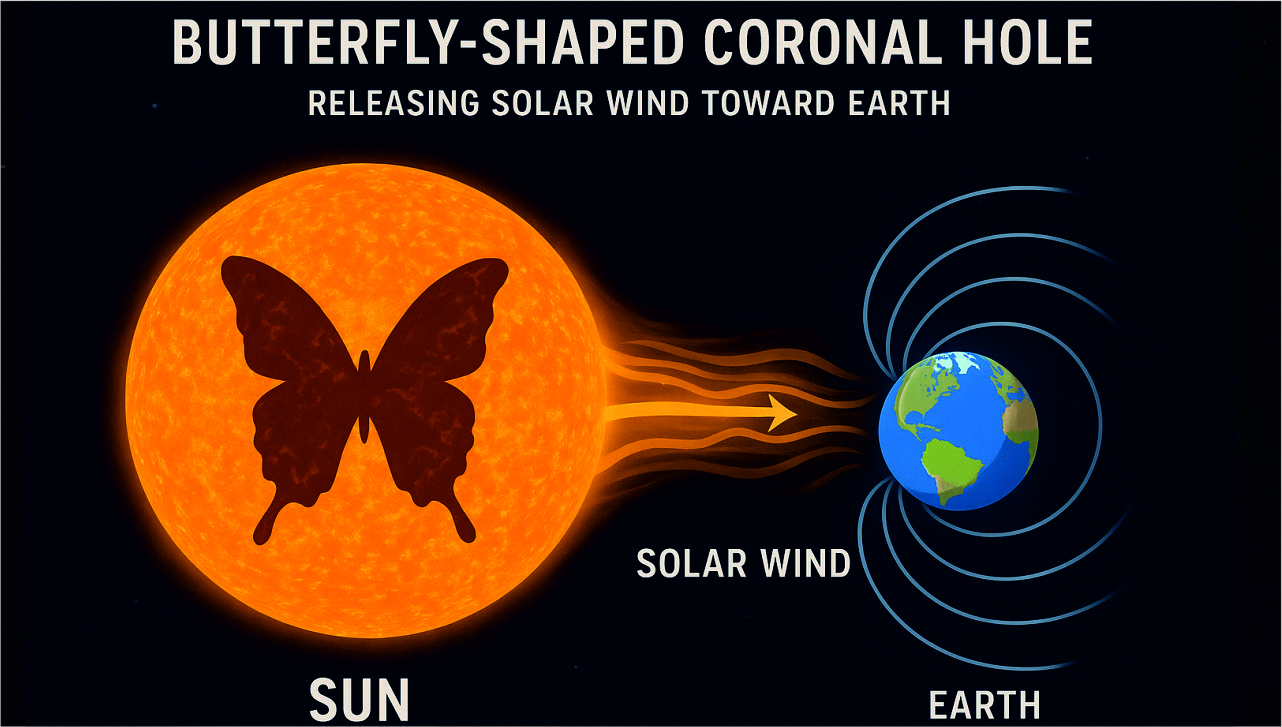
Butterfly Shaped Coronal Hole.
NASA Captures Butterfly-Shaped Coronal Hole on the Sun, Sending Solar Wind Toward Earth
On September 11, 2025, NASA captured a remarkable image of a massive butterfly-shaped coronal hole on the Sun’s surface. This solar feature is releasing a strong stream of charged particles, known as solar wind, which is expected to reach Earth around September 14, 2025.
These powerful solar winds can trigger geomagnetic storms, potentially affecting satellites, communication systems, and other technologies. The risk is especially high near equinoxes due to the alignment of the Sun’s and Earth’s magnetic fields—a phenomenon called the Russell-McPherron effect.
Stay alert as this cosmic event unfolds, as it could bring dazzling auroras and notable impacts on our technological infrastructure.
Butterfly Shaped Coronal Hole on the Sun: Solar Wind Heading Toward Earth
What is coronal hole?
A coronal hole is a region on the Sun’s outer atmosphere (the corona) that is cooler and less dense than its surroundings. These areas have open magnetic field lines that allow high-speed solar wind to escape into space. When directed toward Earth, these streams of charged particles can influence space weather, causing geomagnetic disturbances.
NASA Observation on September 11, 2025
On September 11, 2025, NASA captured a stunning image of a massive butterfly-shaped coronal hole on the Sun’s surface. This rare formation is releasing a strong stream of solar wind directly toward Earth. The unique butterfly shape makes this event visually striking and scientifically significant, highlighting the dynamic nature of the Sun’s magnetic activity.
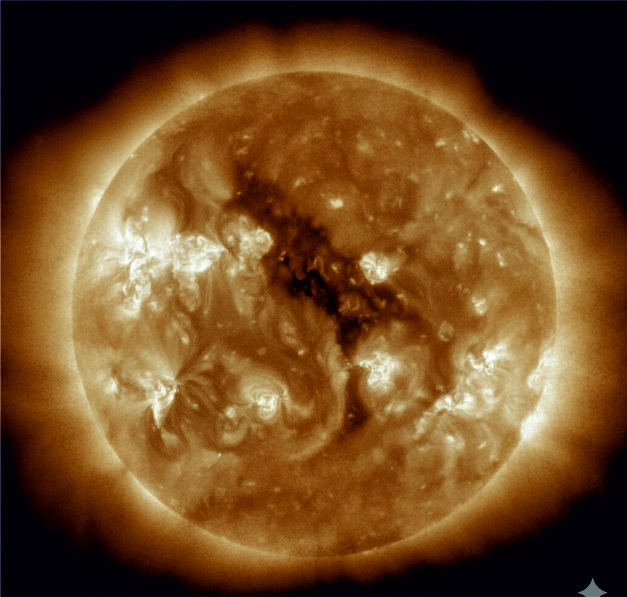
Credit : Courtesy of NASA/SDO and the AIA, EVE, and HMI science teams
Solar Wind and Its Effects
Solar wind is composed of charged particles flowing from the Sun at high speeds. When these particles interact with Earth’s magnetic field, they can trigger geomagnetic storms, which may affect:
- Satellite operations
- Communication networks
- Power grids and infrastructure
- GPS systems
Additionally, geomagnetic storms can create spectacular auroras, visible near the poles and sometimes at lower latitudes during stronger events.
Timing and Forecast
The solar wind from this butterfly-shaped coronal hole was expected to reach Earth around September 14, 2025. Space weather agencies monitor these events to predict the intensity of geomagnetic storms, often categorized using the K-index and G-scale. Accurate forecasting helps mitigate the impact on technology and infrastructure.
Scientific Insight: The Russell-McPherron Effect
The Russell-McPherron effect explains why geomagnetic storms are more likely near the equinoxes. During this period, the Sun’s and Earth’s magnetic fields align in a way that allows solar wind to interact more efficiently with Earth’s magnetosphere, increasing the chances of geomagnetic disturbances.
Potential Impacts on Earth
The incoming solar wind can have several effects on Earth:
- Auroras: Bright northern and southern lights may be visible at higher latitudes, and occasionally at lower latitudes if the storm is strong.
- Satellites: Increased particle flux can interfere with satellite electronics and navigation systems.
- Communication Systems: Radio and GPS signals may experience disruptions.
- Power Grids: Strong geomagnetic storms can induce currents in electrical systems, potentially causing outages.
Historical Context
Coronal holes and their resulting geomagnetic storms have a well-documented history. For instance, in 1989, a strong geomagnetic storm caused a massive blackout in Quebec, Canada, affecting millions. Studying events like the butterfly-shaped coronal hole helps scientists better prepare for future solar storms.
Conclusion
The Sun’s activity directly impacts our technological and natural environment. Monitoring coronal holes and solar wind is essential to safeguard satellites, power systems, and communication networks. As the butterfly-shaped coronal hole heads toward Earth, it serves as a reminder of the dynamic and interconnected nature of our solar system.
Disclaimer:
The information provided in this article is for educational and informational purposes only. While every effort has been made to ensure accuracy, the content may not reflect the most current data or predictions. Readers should not rely solely on this information for decision-making regarding technology, safety, or other critical matters. NASA, NOAA, and other space agencies are the authoritative sources for official space weather forecasts and alerts. The author and publisher are not responsible for any consequences arising from the use of this information.
More about –https://www.nasa.gov/
You May Like – Home
FAQ.
1. What is a coronal hole?
A coronal hole is a cooler, less dense region on the Sun’s outer atmosphere (corona) with open magnetic field lines that allow high-speed solar wind to escape into space.
2. Why is it called a “butterfly-shaped” coronal hole?
The term comes from the shape of the coronal hole observed in solar images, which resembles a butterfly with its wings spread. This shape is rare and visually striking.
3. When is the solar wind from this coronal hole expected to reach Earth?
The solar wind from the butterfly-shaped coronal hole captured on September 11, 2025, was expected to reach Earth around September 14, 2025.
4. What effects can this solar wind have on Earth?
The solar wind can trigger geomagnetic storms, which may impact satellites, GPS and communication systems, power grids, and create visible auroras near the poles.
5. What is the Russell-McPherron effect?
The Russell-McPherron effect is a phenomenon where the Sun’s and Earth’s magnetic fields align near the equinoxes, increasing the likelihood of geomagnetic storms caused by solar wind.
6. How dangerous are geomagnetic storms?
Most geomagnetic storms are not harmful to humans directly, but strong storms can disrupt satellites, communications, and power infrastructure. Precautionary measures are advised for sensitive systems.
7. How do scientists monitor coronal holes and solar wind?
Agencies like NASA and NOAA use satellites such as the Solar Dynamics Observatory (SDO) and other instruments to observe the Sun, track coronal holes, and forecast solar wind impacts on Earth.
8. Can we see auroras from this event?
Yes! Strong geomagnetic storms can produce spectacular auroras, visible at high latitudes and occasionally at lower latitudes if the storm is intense.